
Why I Played a 20-Year-Old Nancy Drew Game Over the Holidays
PUBLISHED IN UNWINNABLE MAGAZINE, ISSUE #171, JANUARY 2024
Author’s note: My piece was selected to be the cover feature of Unwinnable’s monthly issue. A preview of the piece is available to read here on Unwinnable or for purchase as a print-PDF here. I wrote here about my behind-the-scenes experience writing this piece. You can now read the entire piece below.
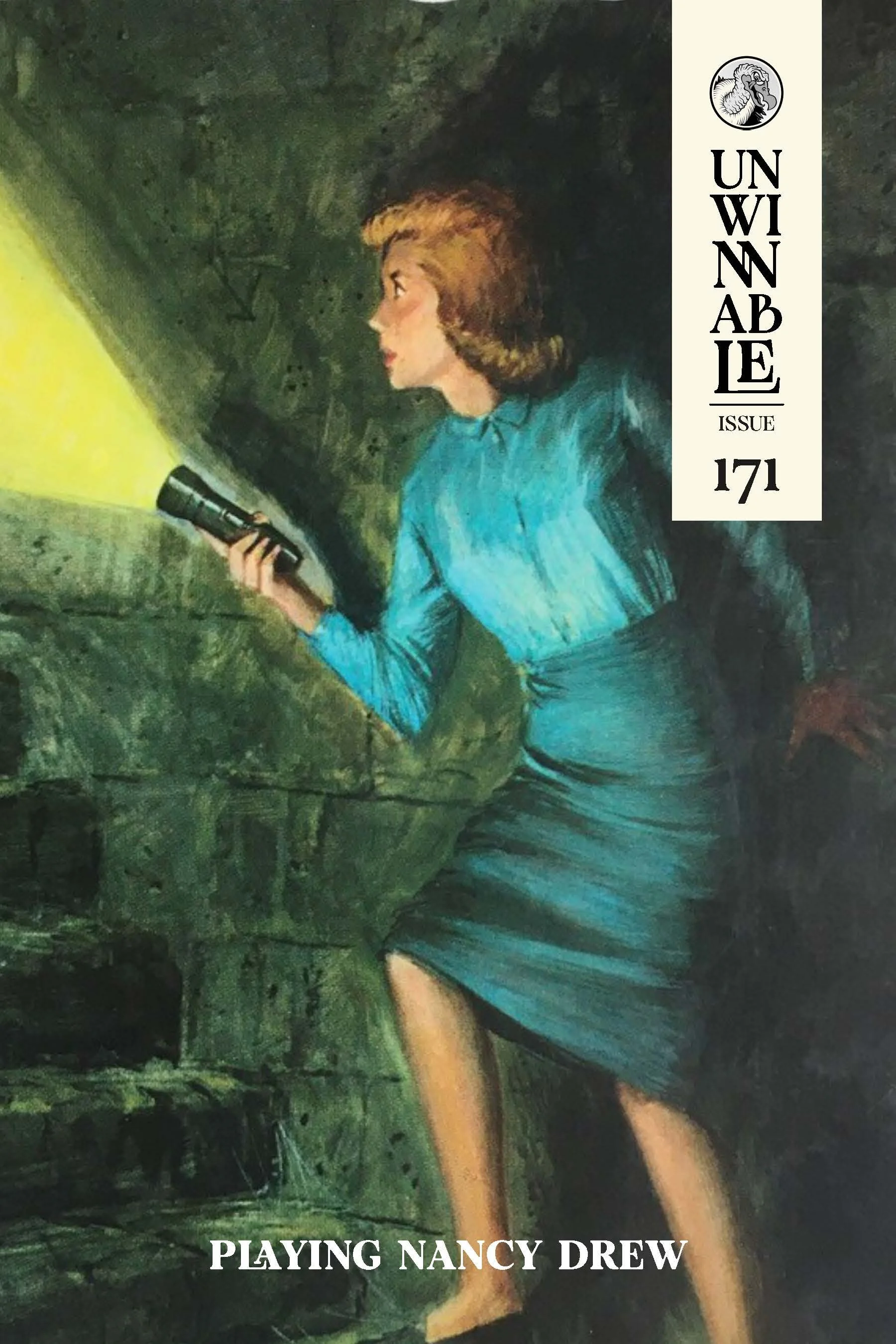


In the basement of American military housing in southern Germany in 2004, my mother, sister, and I crowd around a bulky Dell computer. We have just installed Nancy Drew: Treasure in the Royal Tower, a birth day gift for me from someone who heard I was a nerdy, lonely kid.
We sit there, together, for hours. We guide Nancy through libraries, on snowmobiles, into hidden offices. We use pulley systems, decipher codes and learn about the movement of the stars. We interview suspects, occasionally upsetting them, and take more care next time. We take handwritten notes and, as we approach the finale, we pause and discuss who we think is the master thief. Together with Nancy, we solve the mystery.
* * *
HeR Interactive, a small studio in Washington state, began making Nancy Drew games in 1998, and in the early 2000s, hit a rhythm of releasing two a year. For my mother, sister and I, playing these games became a treasured ritual. We moved often, and the Nancy games became a touchstone of familiarity and comfort. Even when I went away to college, we’d stockpile Nancy Drew games for when I’d come back for the holidays and binge them together.
The “first-person adventures for girls” allowed for my sister and I, and other young players like us, to practice logic, exploration and collaboration. Some required reading in-game books to learn about real-world subjects. My sister was especially adept at mechanical puzzles and my mother was a pro at taking notes, able to recall at a moment’s notice what a suspect had said or how that key we just found might be useful in the greenhouse. I was, admittedly, probably annoyingly bossy. I loved being the main “clicker” with the mouse. My specialty was remembering every explorable location and how to get there.
The games, and the way we played them, challenged each of us to think outside of our comfort zones. I have memories of my mom printing out screenshots of particularly challenging puzzles and having the three of us do it separately by hand.

HeR Interactive / Investigating a ransacked library in Game #4: Nancy Drew: Treasure in the Royal Tower (2001)
Besides just being productive spaces for us as young learners, the Nancy Drew games were a special reprieve for another reason. My father was active-duty military, and he was often away for field rotations, and later, deployments to the Middle East. We were often worried about him, and sometimes struggled to make sense of our rhythms without him. For the three of us, the Nancy Drew PC games invited us into what board game analysts Katie Salen and Eric Zimmerman call “the magic circle.”
In their 2003 book, Rules of Play: Game Design Fundamentals, Salen and Zimmerman describe how “the space of play is separate in some way from that of the real world,” both psychologically and physically, so much so that “the frame of a game creates the feeling of safety.”
Crowded around the computer, the troubles of our real lives faded away. Together, we were able to laugh, sigh, get frustrated (with the game and, occasionally, with each other), discuss, and cheer at resolutions. In the games, Nancy Drew was a hero come to life. And even better, we were her.
* * *
Nancy Drew debuted in The Secret of the Old Clock on May 1, 1930.
Growing up, I was often surrounded by mysteries. Murder, She Wrote was (and is) always on my grandmother’s television. I relished sick days because it meant I got to watch Miss Marple specials on PBS with my mom. But when I got that hardback, yellow-spined book, I finally had a mystery just for me. Even though it’s been almost 100 years since her introduction, Nancy has remained relevant.
Nancy’s ephemeral nature as a quintessential contemporary American woman is intentional. Researchers noted that the writers, illustrators and makers of Nancy Drew always prioritized this sense of being a “modern intellectual,” whatever that meant at the time of her portrayal. Nancy Drew made it through the Depression, World War II, the women’s liberation movement, all while maintaining values of helpfulness, a sense of justice and thoughtfulness (Melanie Rehak, Girl Sleuth: Nancy Drew and the Women Who Created Her, 2006).
As an investigator, Nancy is a consummate professional. She’s strong, but not rude. Smart, but not a know-it-all. She uses technology, but she’s not reliant on it. Some characters will remind Nancy she’s young or relatively inexperienced, but Nancy knows she’s got what it takes. Nancy was an early role model for me on how to be brave, how to stand up for what was right and to hold strong to an idea of my own self-worth.
The characterization even inspired the woman who voiced her in the games. “I grew up reading Nancy Drew books and loved them,” Lani Minella, who voiced Nancy in 31 of HeR Interactive’s games. “I feel very fortunate to have been Nancy's voice for 16 years.”
* * *

HeR Interactive / Game #32: Sea of Darkness (2015) brought players to Iceland.
Mystery video games usually follow a certain formula of receiving a case, investigating for clues and interviewing suspects, then finding the “right” answer. There is a special kind of synergy between the genre and the medium; the act of playing is also one of inquiring, which naturally lends itself to the investigation process.
Empowered by crowdfunding, digital store fronts and social media to reach audiences, independent developers have created a variety of exciting investigations. Giant Sparrow launched the gloriously painful ancestry exploration, What Remains of Edith Finch, to critical acclaim in 2017, winning the BAFTA Award for Best Game and the Game Award for Best Narrative. When Apple Arcade launched in 2019, colorful locked room murder mystery Tangle Tower by brother-duo SFB Games was a flagship title.
I’ve written previously of my love for mystery games. Two indies stand out for diverging from the formula while still honoring the hallmarks of the genre.
In their 2021 game Overboard!, inkle subverted the norm by having players take on the role of a murderer who’s trapped in a time loop as they try to get away with their crime. Jon Ingold, narrative director at inkle shared, “In a traditional story, the protagonist's actions are supposed to be motivated the whole way along, and the writer's job is to ensure there's a link in every step of the chain. We like to aim for that – gameplay where the protagonist's actions and the player's align, without one doing anything that the other doesn't care about – and mys tery is a fantastic way to solve that design problem.”
Paradise Killer, the 2020 debut from Kaizen Game Works allows players to accuse any suspect substantiated with any evidence, challenging players to consider their power, justice and truth.
“For me, the biggest treat when making Paradise Killer was creating the [fantasy] world that the mystery could live in,” Oli Clarke Smith, Co-Founder of Kaizen and Game Director of Paradise Killer. “We started with the outline of the mystery and then the outline of the world, shaping the world to fit the mystery.”
Surroundings are integral to giving higher stakes to an investigation, much less some thing interesting to explore. In the Nancy Drew games, players travel to far flung locales as Nancy to investigate strange circumstances – hauntings in Korea, ghosts in Texas, a kidnapping in Scotland. Games often featured lovingly rendered digital ver sions of a local traditional game, like Scopa in Italy. Each title was thoughtfully researched, and I often learned more interesting things about the world through these games than in my own geography classes.
Nancy’s worldliness inspired me about my own life as a frequently on the move Army brat. I didn’t get to see friends or family that much, but neither did Nancy, and she was doing just great.
* * *
From 2001 to 2014, HeR Interactive released two Nancy Drew games every year.
In later years, I felt like we were finishing the games faster. At first, I wondered if it was because we were getting older, but we started discussing sloppier plots and one-dimensional characters. The once-regular release schedule began to slow; only one game was released in 2015, and nothing else came out for another four years.
We didn’t know it at the time, but HeR Interactive went through major lay-offs in 2015. Production was further slowed by switching, for the first time, from their proprietary game engine to Unity. In 2018, journalist Elizabeth Baillou reported for Kotaku that the studio was “a shell” of its former self.

Game #33, Midnight in Salem (2019), was the studio’s first game to use Unity. It was the first game in four years, and almost five years later, there hasn’t been another.
Without those games, the three of us didn’t know how to connect in the same way. The social fabric of our family was already struggling with changes after I had gone to college and changes to my father’s schedule; losing the Nancy Drew games meant another piece of our rhythm was missing.
In 2019, the 33rd game was released, with a new voice actress as Nancy Drew, to mixed reviews and was riddled with bugs. We couldn’t even get the game to run past the first five minutes. In April 2023, HeR Interactive teased a 34th game on (the website formerly known as) Twitter. Some fans responded with frustration after years of silence. Others responded with hope that the game would come to Nintendo Switch, which I’d personally love to see.
Not only has Nintendo been highly supportive of indies, but the platform’s intuitive controls and mobility lend themselves to echoing the feeling of binge-reading a mystery book. Perhaps most significantly, Nintendo consoles have long made gaming more accessible for femme gamers. Since women are massive consumers of mysteries – women are twice as likely to listen to true crime podcasts than men, and ⅔ of the readers of mystery books in the U.S. are women – the Switch could be a natural choice for ports of the impressive Nancy Drew catalog, much less new releases.
When asked to comment, HeR Interactive was not able to respond in time for publication.
* * *
In the lack of insight about the future, at least we can look to the past. A few years ago, my sister began downloading old games for us to play. We don’t always remember who the bad guy is, and if we do, we promise to keep it to ourselves. Now, we take more breaks for coffee and I don’t hog the mouse (as much). My mom uncovered an archive of our notes from the past twenty years, and we were thrilled to add to it.
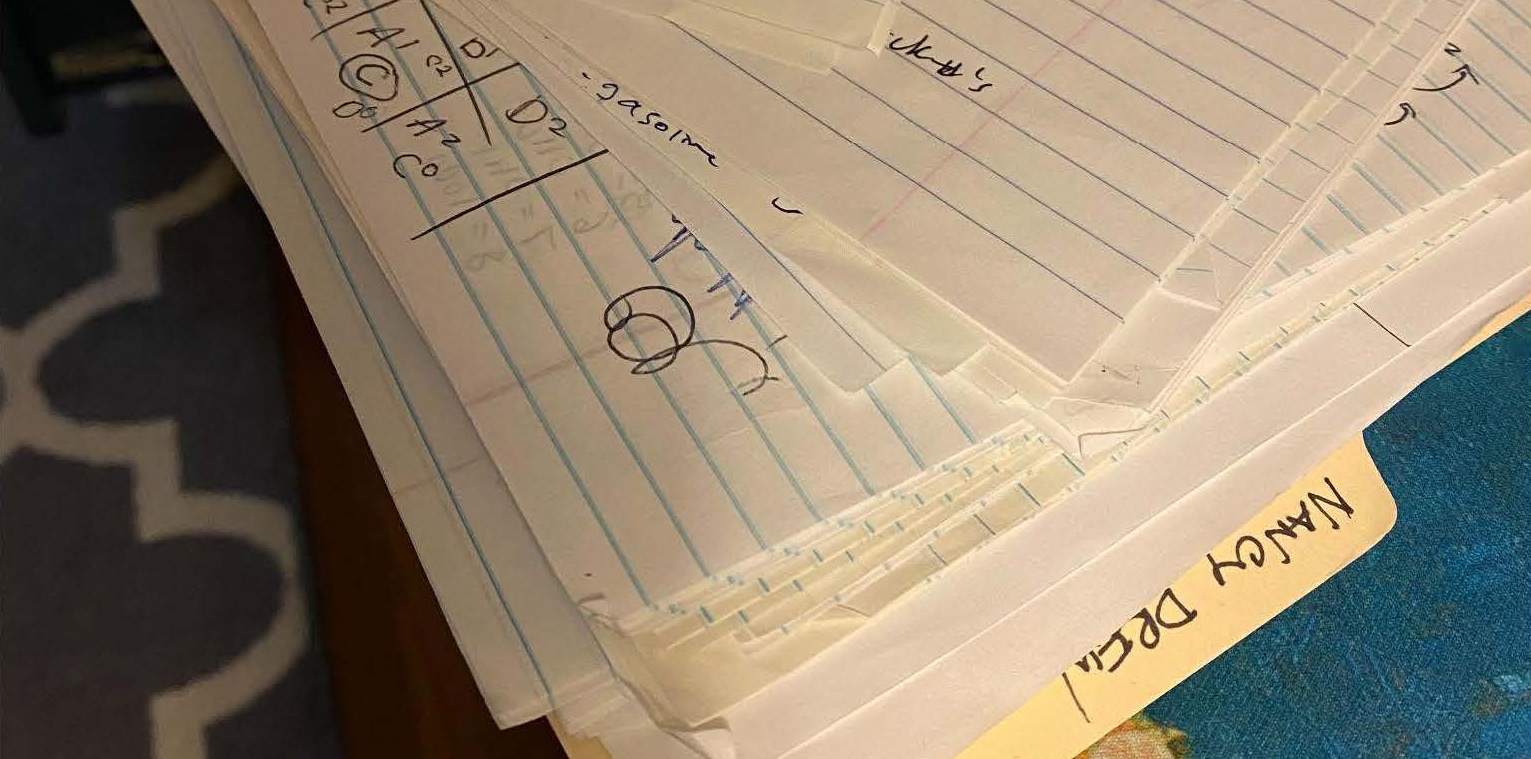
Photo credit: Amanda Tien’s family notes on the Nancy Drew games
HeR Interactive’s Nancy Drew games have had a lasting legacy on my family. They deepened my nascent love of video games and strong female characters, inspiring me and giving me the confidence to game and even begin writing about them. The three of us have inside Nancy Drew jokes. If one of us starts humming the main theme to Curse of Blackmoor Manor, the others will chime in.
We’re not alone in our love of the series. There are hundreds of fan testimonials on the website. Old games are getting new hype on the CozyGamers SubReddit. Comments on a 2021 Refinery21 piece and the aforementioned Kotaku article are filled with people’s personal stories of how the point and-click adventures impacted them. HeR Interactive’s Nancy Drew has been lauded as a feminist icon. There’s even a blog devoted solely to the games’ concept art. Minella reflected, “I was so surprised to find out how beloved [our incarnation of Nancy] was worldwide, and how the games brought families and friends together to play them.”
Video games are a unique form of story telling in that they allow us to be interactive, creating different kinds of powerful memories and experiences. Played together, the effect is spectacular.
We are all getting older. Life’s problems become more complicated. But when I gather around that computer with my mom, sister and Nancy Drew, the world melts away, and all that remains is a mystery to solve.